HDB seller paperwork without agents: your step-by-step guide


Selling your HDB flat without an agent does not have to feel overwhelming. Many homeowners assume the paperwork alone is enough reason to hire someone, but the truth is simpler than you think. HDB has standardized the entire resale process, so the core steps are clearly mapped out and manageable if you know exactly what to do and when. This guide walks you through every document, portal step, and submission sequence you need to handle as a seller, so you can move forward with confidence, save on commissions, and stay in full control of your transaction.
Table of Contents
Key Takeaways
Point | Details |
Paperwork is standardized | HDB sets the paperwork steps so sellers can follow a transparent, predictable process without an agent. |
Main tasks are digital | All major resale submissions, endorsements, and payments happen via HDB’s My Flat Dashboard. |
Supporting documents matter | Missed or incomplete attachments can delay the entire sale, so double-check requirements for each stage. |
Legal help is still key | Even DIY sellers need legal or conveyancing support to finalize the deal and transfer ownership securely. |
Cost savings are real | Managing paperwork directly saves agent commissions but requires careful attention to detail. |
What selling without an agent really means
When you choose to sell your HDB flat without an agent, you are not taking on a mysterious or complicated task. You are simply shifting responsibility for managing the paperwork and portal steps from an agent to yourself. The process itself does not change. HDB has built a clear, standardized workflow that any homeowner can follow.
Selling HDB yourself means you personally log into HDB’s My Flat Dashboard to register your Intent to Sell, grant the Option to Purchase (OTP), submit the resale application, and endorse your documents. These are the same steps an agent would take on your behalf. You are not creating new work. You are doing the work the agent was doing for you.
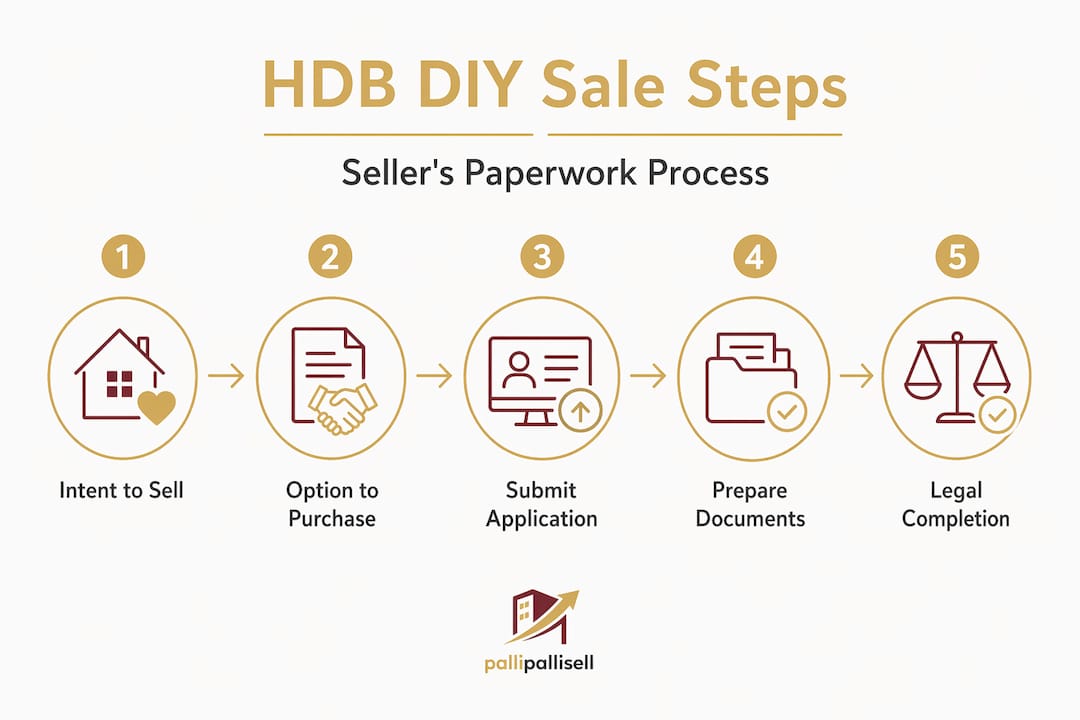
Here is what the overall process looks like at a high level:
Register your Intent to Sell on HDB’s My Flat Dashboard
Negotiate and grant the Option to Purchase (OTP) to your buyer
Submit your portion of the joint resale application
Upload all supporting documents required by HDB
Endorse resale documents and pay the necessary fees
Wait for HDB’s final approval and proceed to completion
As the Council for Estate Agencies confirms, selling without an agent mainly shifts responsibility for managing and submitting the required HDB resale portal workflow from an agent to the homeowner, but the core paperwork steps are standardized by HDB.
The biggest misconception is that DIY sellers face harder paperwork. The reality is that HDB has made the process transparent and accessible. What changes is who clicks the buttons and uploads the files. That person is you.
Understanding this framing matters. A no-agent sale commission saving of 1% to 2% on a $500,000 flat can translate to $5,000 to $10,000 in your pocket. That is a compelling reason to take ownership of the process.
Now that you know the overall structure of a no-agent sale, let’s walk through the precise paperwork journey you must follow.
Step-by-step breakdown: HDB resale paperwork flow
Each stage of the HDB resale process is handled through HDB’s My Flat Dashboard. This is your single control center for the entire transaction. You do not need to visit HDB in person for most steps. The portal guides you through each submission clearly and sequentially.
Here is the step-by-step HDB sale process broken down:
Register Intent to Sell. This is your first official step. You log into My Flat Dashboard and register your intent. This triggers an eligibility check for your flat and notifies HDB that you plan to sell. Only after this step are you legally permitted to grant an OTP to a buyer.
Grant the Option to Purchase (OTP). Once you have found a buyer and agreed on a price, you issue the OTP. The buyer pays an Option Fee (up to $1,000). They then have between 21 days (standard) to exercise it. As confirmed by the Council for Estate Agencies, the seller must register an Intent to Sell via HDB’s My Flat Dashboard before proceeding to grant an OTP.
Submit the resale application. After the buyer exercises the OTP, both parties submit their respective portions of the resale application. You handle the seller’s portion through the My Flat Dashboard. You upload supporting documents at this stage. Both portions must be submitted within 7 days of each other. According to the Council for Estate Agencies, after buyers exercise the OTP, seller and buyer must submit their respective portions of the resale application through HDB on the My Flat Dashboard.
Endorse documents and pay fees. Once HDB reviews your application, you will be asked to endorse resale documents digitally and pay the required resale levy or administrative fees. This endorsement is your formal acknowledgment of the transaction terms. As noted by the Council for Estate Agencies, the seller needs to endorse resale documents and pay the necessary fees before HDB grants approval.
HDB approval and completion. Once all parts are endorsed and fees are paid, HDB schedules the completion appointment. This is when ownership officially transfers.
Stage | Action required from seller | Where it happens |
Intent to Sell | Register eligibility and intent | My Flat Dashboard |
OTP | Issue to buyer, monitor exercise window | My Flat Dashboard / paper OTP |
Resale application | Submit seller’s portion, upload documents | My Flat Dashboard |
Endorsement and fees | Sign digitally, pay administrative fees | My Flat Dashboard |
Completion | Attend HDB appointment | HDB Hub or online |
Timing matters. HDB typically processes resale applications within 8 to 10 weeks from the date both portions are received, assuming all documents are in order. Any missing or incorrect information can push that timeline back significantly.
Pro Tip: Before you even list your flat, complete the Intent to Sell registration. This checks your eligibility upfront so you avoid surprises midway through negotiations with a buyer.
With a grasp on the big picture, let’s dig into each required document and dashboard step so you can prepare efficiently.
Essential documents and supporting evidence you must prepare
Knowing the steps is only part of the equation. You also need to gather the right documents and have them ready before each submission stage. Missing a single document can freeze your application and delay your timeline by days or even weeks.
Here is what you need to prepare:
Identity documents: NRIC of all owners and occupiers listed on the flat
Proof of ownership: Your HDB title or lease information (accessible via My Flat Dashboard)
Financial documents: CPF withdrawal statements if you used CPF to purchase the flat, outstanding loan details from HDB or your bank
Special circumstances paperwork: If you need an extension of stay after the resale, you must submit a formal request with supporting justification
Ethnic Integration Policy (EIP) and Singapore Permanent Resident (SPR) quota compliance: Your buyer must confirm eligibility, but you need to be aware of these restrictions when screening buyers
Outstanding arrears clearance: Any outstanding town council conservancy charges or HDB loan must be settled before completion
A resale application is only complete when HDB receives both the buyer’s and seller’s portions plus all necessary supporting documents. Partial submissions cause delays and can jeopardize your transaction timeline.
HDB’s guidelines are clear: avoid partial submissions and missing attachments to reduce delays. DIY sellers must treat document completeness as non-negotiable.

Task | With an agent | Without an agent |
Gathering NRIC and identity docs | Agent reminds you | You prepare and upload yourself |
Tracking submission deadlines | Agent monitors | You monitor My Flat Dashboard |
Uploading supporting documents | Agent uploads | You upload directly |
Responding to HDB queries | Agent liaises | You respond directly |
Paying fees on time | Agent advises | You track and pay yourself |
Pro Tip: Create a dedicated folder (physical or digital) for every document related to your flat sale. Label each file clearly and organize it by stage. This simple step saves hours when you reach the submission stage.
Saving on home sale costs is the primary motivation for most DIY sellers, but document readiness is what actually protects those savings. A delay caused by a missing document can push back your completion date and result in penalty costs if you have already committed to a purchase timeline.
Now that you’re clear on the paperwork stages, let’s spotlight where you still need professional help, even as a DIY seller.
Why legal and conveyancing support still matters
Managing HDB portal steps yourself does not mean you handle every part of the transaction alone. One area where professional support remains important is legal conveyancing. This is the legal process that handles fund transfers, title registration, and official submissions to HDB and the Land Titles Registry.
Even experienced DIY sellers typically engage a conveyancing lawyer to manage these elements. As property experts confirm, DIY sellers still typically use conveyancing support even if they do not use an agent. The HDB resale workflow itself is handled via portal steps, but legal matters require a qualified professional.
Skipping conveyancing to save more money is one of the most common and costly mistakes DIY sellers make. The risk is simply not worth it.
Here is where a conveyancing lawyer steps in for sellers:
CPF refund processing: If CPF funds were used to purchase the flat, the refund process must be handled correctly at completion
Outstanding mortgage discharge: Your lawyer ensures any existing bank or HDB loan is discharged properly when the flat transfers
Title transfer registration: The lawyer formally registers the change of ownership with the Singapore Land Authority
Stamping of legal documents: Buyer and seller documents must be properly stamped according to legal requirements
Coordination with buyer’s lawyer: Your lawyer liaises with the buyer’s legal team to ensure funds are transferred and ownership changes correctly
Legal fees for conveyancing in Singapore typically range from $1,500 to $2,500. This is far lower than the agent commissions you are saving, and it protects you from costly legal errors.
For legal tips for HDB sellers, the key takeaway is simple: manage the HDB portal steps yourself, but always engage a conveyancing lawyer for the legal completion. These are two separate roles, and confusing them can cost you significantly more than you save.
What most HDB sellers get wrong about DIY paperwork
Here is the honest take: most sellers who struggle with DIY paperwork do not fail because the process is too hard. They fail because they underestimate the importance of accuracy at each stage.
The most common mistake is relying on memory or outdated information instead of checking the current HDB portal checklist before each submission. HDB updates its requirements and portal interfaces periodically. What worked for your neighbor two years ago may not reflect the current process. Always verify requirements directly on My Flat Dashboard before you submit anything.
Rushing submissions is another serious problem. Many sellers feel pressure to move quickly once a buyer is found and push through documents without double-checking completeness. A rushed, partial submission that gets rejected by HDB does not speed up your sale. It slows it down and can create tension with your buyer.
The sellers who navigate DIY paperwork successfully share a few key habits. They prepare documents well before they need them. They track every deadline in a simple calendar or checklist. They engage their conveyancing lawyer early, not at the last minute. And they treat the HDB portal as their primary reference, not secondhand advice from forums or acquaintances.
Transparency is not just a nice-to-have in a DIY sale. It is your protection. Every submission you make through the HDB portal is timestamped and recorded. If a dispute arises, that record works in your favor. If your submission is incomplete, that record also shows the delay was on your end.
The FSBO reality is that selling your own flat is absolutely achievable, but it rewards preparation. Sellers who treat paperwork as a minor afterthought usually find themselves scrambling. Sellers who treat it as a structured project manage it smoothly and keep their savings intact.
Need support navigating your HDB resale paperwork?
Handling your own HDB paperwork is absolutely within reach, especially when you have the right tools and guidance from the start. At Pallipallisell.com, we help DIY sellers move through each step with clarity and confidence, without the cost of a traditional agent.
Our flat fee of just $688 gives you access to listing support, direct buyer communication, and practical resources to guide you through each stage of the resale process. You keep full control of your sale while saving thousands in agent commissions. Check out our affordable HDB selling fee to see exactly what you get. Browse current HDB listings to see how other sellers are presenting their flats. When you’re ready to list and move forward, visit Pallipallisell.com to get started on your own terms.
Frequently asked questions
What portal do I use to process HDB resale paperwork as a seller?
Sellers must use HDB’s My Flat Dashboard to register Intent to Sell, grant the Option to Purchase, and manage all resale paperwork and submissions throughout the transaction.
What counts as a complete resale application for HDB?
A resale application is complete only once both the seller and buyer have submitted their portions and all supporting documents have been received and verified by HDB.
Can I skip legal or conveyancing support if I manage the HDB paperwork myself?
No. Legal and conveyancing support is still necessary for funds transfer and title registration. DIY sellers still use conveyancing lawyers even when they self-manage all HDB portal steps.
What happens if I submit incomplete HDB resale documents?
Incomplete or missing documents will delay HDB’s approval and can postpone your entire transaction timeline. Avoid partial submissions and always confirm document completeness before submitting.
Is the paperwork harder without an agent?
Not necessarily. Core paperwork steps are standardized by HDB so homeowners can handle them directly. The main shift is that you manage submissions yourself rather than delegating to an agent.
Recommended


Comments