How to start your FSBO property sale in Singapore


Selling your home without paying a real estate agent commission sounds appealing, and the math is hard to argue with. On a $600,000 HDB flat, a 2% commission means $12,000 gone before you see a dollar. On a $1.5 million condo, that figure jumps to $30,000 or more. More Singapore homeowners are choosing to go the For Sale By Owner (FSBO) route every year, but the process is not as simple as posting a listing online. There are official portals, legal requirements, eligibility checks, and marketing limitations that you need to navigate carefully. This guide breaks it all down, step by step, for both HDB and private property sellers.
Table of Contents
Key Takeaways
Point | Details |
Official steps first | For both HDB and private FSBO, you must start with platform-defined eligibility and official workflows. |
Contract compliance | Legal documentation and CEA checklists are essential for private property FSBO, not just marketing. |
Exposure challenges | DIY sellers face marketing limitations and must use official channels plus alternative platforms. |
Pro tips help | Expert advice on maximizing exposure and avoiding common mistakes can make FSBO more successful. |
Affordable options | You can access low-fee listing support and browse FSBO properties if you know where to look. |
Understanding FSBO property sale in Singapore
FSBO stands for For Sale By Owner. In Singapore, it means you handle the sale of your property directly, without hiring a licensed real estate agent to represent you. You manage the listing, negotiate with buyers, prepare documents, and close the deal yourself.
The process looks different depending on whether you own an HDB flat or a private property. Each has distinct regulatory requirements, official portals, and legal steps. Understanding these differences upfront saves you time and prevents costly mistakes.
Here is a quick side-by-side comparison:
Category | HDB Flat | Private Property (Condo / Landed) |
Governing body | Housing & Development Board (HDB) | Council for Estate Agencies (CEA) |
Starting step | Register Intent to Sell | Familiarize with CEA rules |
Key portal | HDB Flat Portal / My Flat Dashboard | CEA-approved checklists and templates |
Contract documents | HDB-prescribed forms | Option to Purchase (OTP) and S&P Agreement |
Agent requirement | Not mandatory | Not mandatory |
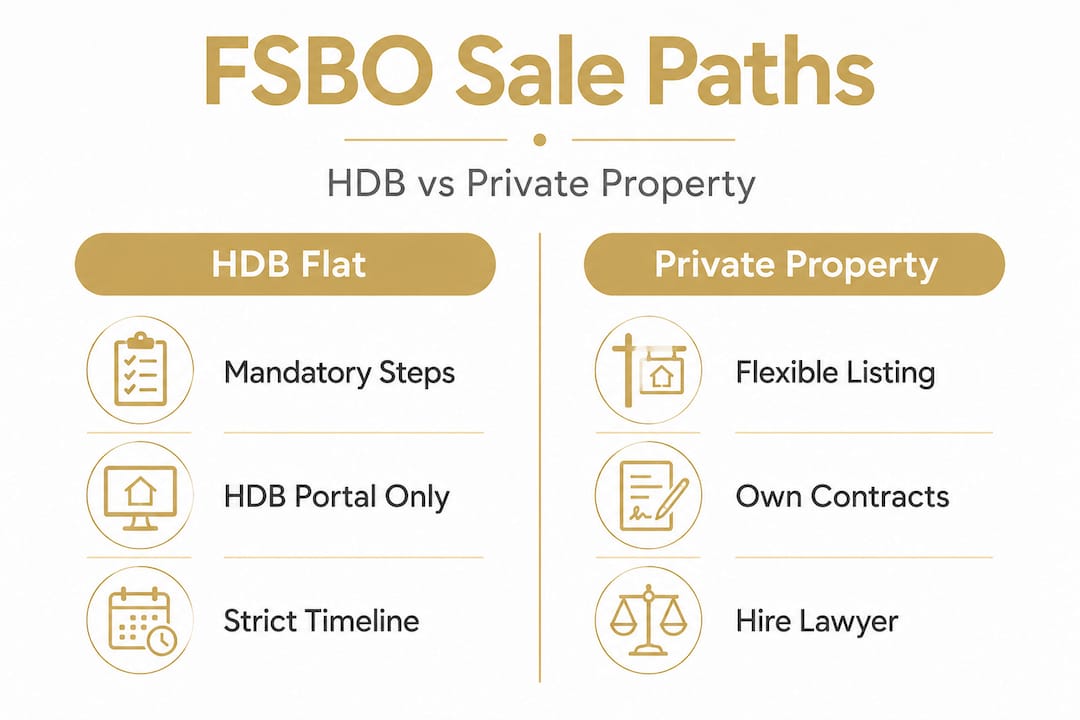
Both paths allow you to sell without an agent. However, you still follow mandated official workflows. The biggest difference is that HDB resale has a much more structured, government-controlled process, while private property FSBO gives you more flexibility but requires stronger legal awareness.
For both types, you should weigh the FSBO pros and cons carefully before committing. Knowing the full picture helps you plan realistically.
Key requirements for HDB FSBO sellers:
Must meet Minimum Occupation Period (MOP) before selling
Must register Intent to Sell as the official legal starting point, as required by HDB’s resale portal
Eligibility checks happen automatically through My Flat Dashboard
Key requirements for private property FSBO sellers:
Must understand CEA regulations before listing
Must use official contract templates, as the CEA advises for private sellers
Should work with a conveyancing lawyer even when self-transacting
Required steps for HDB FSBO: Process and checklist
With a clear FSBO foundation, let’s walk through the step-by-step process for HDB homeowners starting the sale on their own.
The HDB resale process follows a government-mandated sequence. You cannot skip steps, and the official starting point is non-negotiable. Here is what you do:
Register your Intent to Sell through HDB’s My Flat Dashboard. This is the legal first step. It triggers eligibility checks and confirms whether you have met the MOP and other conditions.
Review your eligibility results. The dashboard will tell you what you can and cannot do. If there are outstanding loans or restrictions, they will appear here.
List your flat. After registering, you can list via your preferred channels or through HDB’s Resale Flat Listing (RFL) service on the HDB Flat Portal. This is a fully DIY-compatible step.
Respond to buyer inquiries and arrange viewings. You handle all communication directly with potential buyers.
Grant the Option to Purchase (OTP). Once you agree on a price, you issue the OTP to the buyer. HDB prescribes specific forms for this.
Submit the resale application. Both buyer and seller submit their portions through the HDB Resale Portal within set timeframes.
Attend the HDB appointment. This is the final completion step where ownership is officially transferred.
Document | When needed |
NRIC / Passport | Throughout the process |
HDB Flat Details printout | When registering Intent to Sell |
CPF withdrawal statement | Before submission |
Outstanding loan statement | At application stage |
Executed OTP | After price agreement |
For more detailed agent-free HDB sale tips, including how to handle negotiations confidently, it helps to prepare well in advance. You should also review sell HDB fast tips to reduce the time your flat sits on the market.
Pro Tip: Register your Intent to Sell at least two weeks before you plan to list. The registration unlocks eligibility information you need before approaching buyers. Starting early gives you time to resolve any unexpected conditions that show up on your dashboard.
Required steps for private property FSBO: Contracts and compliance
After HDB, let’s shift focus to private properties, where the steps and risks differ but the potential commission savings remain substantial.
Selling a condo or landed property without an agent is legally allowed in Singapore. But you carry more responsibility for getting the contracts right. The CEA lays out a clear process for self-transacting private sellers, and following it closely protects you legally.
Here are the key steps:
Familiarize yourself with CEA rules and regulations. This is Step 1 as outlined by the CEA. Understanding what you can and cannot do as a self-transacting seller is your starting point.
Go through the official CEA checklists. The CEA provides checklists for private property sellers covering everything from disclosure obligations to payment timelines. Do not skip this step.
Prepare your property and set your price. Research comparable transactions using URA’s data. Be accurate. Overpricing stalls a sale and underpricing costs you money.
List your property and market it actively. This is where you attract buyers.
Negotiate terms directly with the buyer. Without an agent, you control this conversation entirely. Know your minimum acceptable price and preferred timeline before you enter any negotiation.
Sign the Option to Purchase (OTP). The OTP locks in the buyer’s right to purchase within a set period. Use the standard CEA template. Do not create your own.
Proceed to the Sale and Purchase (S&P) Agreement. Your conveyancing lawyer drafts and finalizes this after the OTP is exercised. The OTP and S&P are standard templates prescribed for private residential transactions.
Complete all stamp duty obligations and legal transfers. Your lawyer handles the technical execution, but you need to understand the timeline.
Common compliance pitfalls to avoid:
Signing a non-standard OTP without legal review
Failing to disclose known defects in the property
Not understanding the buyer’s stamp duty implications when negotiating
Missing the deadline to exercise the OTP
Overlooking CPF charge discharge requirements if your flat has an existing CPF charge
For a full breakdown of private FSBO requirements, including what the CEA expects from self-transacting sellers, review the linked resource before you start negotiations.
Pro Tip: Hire a conveyancing lawyer early. Even in a FSBO sale, a lawyer reviews your contracts, handles the legal transfer, and flags compliance issues before they become expensive problems. Legal fees for conveyancing typically range from $1,500 to $3,000, which is still far less than a full agent commission on most private properties.
Channel access and exposure: How to market your FSBO property
Listing and marketing are arguably the greatest barrier to FSBO success. Let’s explore how you can maximize exposure and overcome these channel constraints.
Here is the hard truth: not all listing platforms are open to you as a self-transacting seller. Major property portals in Singapore restrict listings to licensed agents, which means DIY sellers are cut off from the most heavily trafficked search channels. This is a real disadvantage you need to plan around.
“Listing distribution and exposure may be the main non-legal barrier to going agent-free for HDB resale. If buyers heavily search agent-accessible portals, DIY sellers may need to compensate with alternative marketing channels.” (Property Noob)
This does not mean you cannot attract serious buyers. It means you need to work smarter and use every available channel effectively.
Channels available to FSBO sellers:
HDB Flat Portal (RFL service): The official HDB listing channel, open to self-transacting sellers. Buyers actively search here.
Carousell: A general marketplace where DIY sellers regularly list properties. It has a large local audience and is free to use.
Facebook Marketplace and groups: Singapore property buyer groups on Facebook receive significant traffic. Posting in multiple relevant groups increases your reach.
WhatsApp and Telegram channels: Property-focused community channels exist across Singapore. Sharing your listing in these groups reaches active buyers.
Direct outreach to buyers: If your property is in a popular development, posting in resident community groups or noticeboards reaches people already familiar with and interested in the area.
FSBO-focused platforms: Digital platforms built for self-transacting sellers, like Pallipallisell.com, give you structured listing tools and a targeted buyer audience without the agent requirement.
Understanding the no commission property impact helps you see why getting channel strategy right matters so much for maximizing your net proceeds.
For a full walkthrough on DIY home selling without paying commission, including which platforms deliver results, that resource provides practical, tested guidance. You can also find quick FSBO sale tips for compressing your timeline without sacrificing price.
Pro Tip: Take high-quality photos before listing anywhere. Listings with clear, well-lit photos receive significantly more inquiries than those with dark or blurry images. Use natural light, shoot from the corner of each room, and include all major spaces including the kitchen, bathrooms, and any unique features like a study or balcony. A strong first visual impression converts browsing to action.
Our take: What most guides miss about FSBO selling in Singapore
Most FSBO guides focus on the money you save. That part is straightforward. What they often miss is the mindset shift required to do this well.
Many sellers approach FSBO thinking it means “do whatever you want.” It does not. In Singapore’s context, FSBO means self-transacting while still following mandated official workflows. You bypass the agent, not the system. That distinction matters enormously.
We have seen sellers stall their transactions by treating the HDB resale process as optional or informal. It is not. The Intent to Sell registration, the prescribed OTP format, the portal submission timelines, none of these are suggestions. They are steps with real legal and financial consequences if missed.
For private property sellers, the legal documentation risk is even higher. Using a non-standard contract or misunderstanding the OTP timeline can result in a collapsed deal, legal disputes, or financial penalties. The savings are real, but only when the process is executed correctly.
The other gap most guides ignore is the listing exposure problem. Sellers sometimes list on HDB’s portal and Carousell, receive little response, and conclude that FSBO “doesn’t work.” What actually happened is that they reached only a fraction of the buyer market. Without a strategy to compensate for the major portal restrictions, your listing simply does not get seen by enough buyers.
The sellers who succeed at FSBO treat it like a project with two parallel tracks: compliance management and buyer outreach. Both need attention. Skimping on either creates problems. For an honest look at what the real FSBO experience involves, including the challenges alongside the rewards, that resource is worth reading before you decide.
Our honest view: FSBO in Singapore is genuinely viable for sellers who prepare carefully, follow every official step, and invest real effort into marketing. It is not a shortcut. It is a trade. You trade agent convenience for significant financial savings, but only if you do the work.
Next steps: Streamline your FSBO journey with expert support
You now have a clear roadmap for FSBO in Singapore, whether you are selling an HDB flat or a private property. The steps are manageable, the savings are real, and you do not need to pay a full commission to get professional support along the way.
Pallipallisell.com exists to make this process easier and more affordable for homeowners like you. For a fixed fee of just $688, you get a structured listing, direct buyer access, and full control over your sale without giving up thousands in commission. Browse our low-cost FSBO pricing to see exactly what is included, and explore active FSBO property listings to understand how other sellers are presenting their homes. You handle the negotiation and the decision. We give you the platform and the visibility. It is that straightforward.
Frequently asked questions
What is the first step to start FSBO for an HDB flat?
You must register your Intent to Sell through HDB’s My Flat Dashboard, which runs eligibility checks and officially unlocks the resale listing process for your flat.
Can I list my HDB flat on general property portals like PropertyGuru?
No. Major portals are restricted to licensed agents. As a DIY seller, you can use HDB’s portal or general marketplaces like Carousell to reach buyers directly.
What documents do I need to sell private property FSBO in Singapore?
You need the standard Option to Purchase and Sale and Purchase Agreement. The CEA provides standard contract templates for both documents as part of the official self-transacting process.
How can FSBO sellers maximize exposure for their listings?
Use the HDB Flat Portal, Carousell, Facebook Marketplace, and Telegram property groups to compensate for portal restrictions. Since major portals gate DIY sellers out, spreading your listing across multiple platforms significantly increases your buyer reach.
Recommended


Comments