Real Estate Commission Percentage Explained for Singapore Sellers

If you’re preparing to sell your HDB flat or private property in Singapore, the real estate commission percentage explained in this guide will save you from costly surprises. Many sellers assume commission rates are fixed by law, or that there’s no room to negotiate. Neither is true. Commissions in Singapore are benchmarked by industry guidelines, not mandated by regulation, which means you have more control than you think. This guide breaks down exactly how real estate commissions work, what you’ll pay on HDB and private sales, and how to reduce those costs without losing buyer interest.
Table of Contents
Key Takeaways
Point | Details |
HDB commission is ~2% | Seller-side HDB commission is typically 2% plus 9% GST if your agent is GST-registered. |
Rates are not fixed by law | The CEA sets industry benchmarks, but all commission rates are negotiable between you and your agent. |
Co-broke splits affect your cost | In co-broke deals, your 2% commission is often split 1% each between seller and buyer agents. |
Low-commission models exist | Choosing a 1% or fixed-fee model can save thousands, but you should verify what services are included. |
Cutting buyer agent fees carries risk | Reducing or removing buyer agent incentives can lower showing traffic and slow your sale. |
How real estate commissions work in Singapore
Understanding real estate commission percentage explained at the transaction level starts with knowing who pays what and when.
In Singapore, the seller typically pays their own agent’s commission. For HDB resale flats, the seller-side commission is approximately 2% of the transaction price, plus 9% GST if your agent is GST-registered. On a S$600,000 HDB flat, that’s S$12,000 in commission plus S$1,080 in GST. That’s a real number, and it comes out of your sale proceeds at completion.
For private condominiums, condo seller commission ranges between 1% and 2%, with 2% being the common benchmark. High-value properties often see rates negotiated down to 1% or 1.5% because the absolute dollar amount is already large.
Buyer-side commissions and co-broke splits
Here’s where it gets more nuanced. If your buyer uses their own agent, that buyer’s agent typically earns ~1% buyer commission from the buyer directly. In co-broke arrangements, the seller’s 2% commission is often split 1% each between the seller’s agent and the buyer’s agent. This means the headline rate you see may actually cover two agents, not one.
The practical implication: your total commission outlay can approach 3% when you account for both sides. Knowing this upfront helps you budget accurately and negotiate from a position of clarity.
Property Type | Typical Seller Commission | GST (if applicable) | Buyer Agent Fee |
HDB Resale | ~2% | +9% | ~1% (paid by buyer) |
Private Condo | 1%–2% | +9% | ~1% (paid by buyer) |
Landed Property | 1%–2% | +9% | Negotiable |
Commission is paid at completion of the sale, not upfront. Planning for commission at that stage affects your cash flow, especially if you’re coordinating a simultaneous purchase.
Pro Tip: Always ask your agent upfront whether their quoted commission is inclusive or exclusive of GST. “2%” can mean very different amounts depending on that single detail.
Are commission rates negotiable?
Yes. Completely. This is one of the most misunderstood aspects of the Singapore property market.
Commission rates in Singapore are benchmarked by the Council for Estate Agencies (CEA) as part of their Code of Ethics and Professional Client Care, but they are not legally fixed. You can negotiate below or above those benchmarks based on your situation. The CEA framework exists as a guideline, not a ceiling.
Factors that affect your negotiating position include:
Property value. A S$1.5 million condo at 1% still earns the agent S$15,000. Larger deals often come with more room to negotiate down.
Sale complexity. A well-priced flat in a sought-after estate with clear paperwork takes less effort to sell. You can make that case to your agent.
Exclusivity. Agents often agree to lower rates in exchange for an exclusive listing agreement, since they’re guaranteed the deal.
Market demand. In a hot market with strong buyer interest, agents may accept a lower percentage because the sale will close faster with less effort.
Negotiation success depends on the specifics you bring to the table. Sellers who arrive with recent comparable sale prices, a clear property condition assessment, and a realistic timeline consistently get better outcomes than those who just ask for a discount.
The most common outcome of successful negotiation is 1% instead of 2% for HDB sellers, or 1% to 1.5% for condo sellers, especially on properties above S$800,000. That’s a meaningful difference. On a S$900,000 flat, dropping from 2% to 1% saves you S$9,000 before GST.
Pro Tip: Anchor your commission negotiation with data, not emotion. Tell your agent the recent transacted prices in your block, your renovation status, and your preferred timeline. Concrete details justify a lower rate far better than simply saying “your fees are too high.”
Full-commission vs. low-commission selling models
Not all seller arrangements are created equal. Knowing what you get at each price point helps you make a smarter decision.
Traditional 2% commission service
At 2%, you typically receive a full-service package. This includes property valuation, professional photography, listing placement on major portals, buyer viewings management, negotiation support, and paperwork coordination through to completion. For sellers who want minimal involvement or are selling a complex property with tenancy issues, this level of service has real value.
The trade-off is cost. On a S$700,000 flat, you pay S$14,000 in commission. Add GST, and it’s S$15,260.
1% commission models
Opting for a 1% model cuts that S$14,000 to S$7,000 on the same property. That’s a significant saving. These models typically rely more on technology for listing distribution and use digital channels over traditional agent networking. Some services in this space offer streamlined support with fewer in-person touchpoints.
The key question to ask any 1% agent: exactly which services are included and which are not?
Feature | 2% Full-Service Agent | 1% Commission Model |
Professional photography | Yes | Sometimes |
Buyer negotiation support | Yes | Limited |
Open house management | Yes | Rarely |
Portal listing | Yes | Yes |
Paperwork coordination | Yes | Yes |
Co-broke buyer agent payout | Included in 2% | May be separate |
One important consideration: low or no buyer agent commission reduces the incentive for buyer’s agents to bring their clients to your property. This can cut showing traffic, which directly affects how fast you sell. If you choose a lower-commission model, factor in whether the listing offers co-broke to buyer agents or not.
Pro Tip: Before signing with any 1% agent, ask directly: “Does your fee include a co-broke payout to buyer agents?” If not, factor that cost into your comparison.
Practical ways to reduce your commission costs
You don’t have to accept the first number on the table. Here’s how to approach commission costs strategically.
Negotiate before signing any agreement. Once you sign an exclusive listing agreement, your leverage drops. Have the commission conversation before you commit.
Get multiple quotes. Contact two or three agents and compare not just the rate, but the service scope. A detailed real estate agent comparison helps you assess real value.
Consider selling without an agent. For HDB resale flats, the HDB Resale Portal allows you to manage the transaction yourself. You handle buyer queries, viewings, and negotiations directly. The savings can be substantial.
Use a fixed-fee listing service. Platforms like Pallipallisell offer fixed-fee support for a fraction of traditional commission costs, giving you listing visibility and transaction guidance without the percentage-based fee.
Verify GST registration upfront. Ask your agent for their GST registration number. If they are not registered, you should not be paying GST on top of their commission. Confirm this in writing before agreeing to any fee.
Plan for commission at completion. Standard sale timelines run 8 to 12 weeks for HDB and 10 to 12 weeks for private property. Know exactly when commission becomes due and how it will be deducted from your proceeds.
For HDB sellers specifically, the resources at HDB fee breakdown 2026 provide a detailed walkthrough of all seller-side costs to help you budget accurately.
Total selling costs: what sellers actually pay
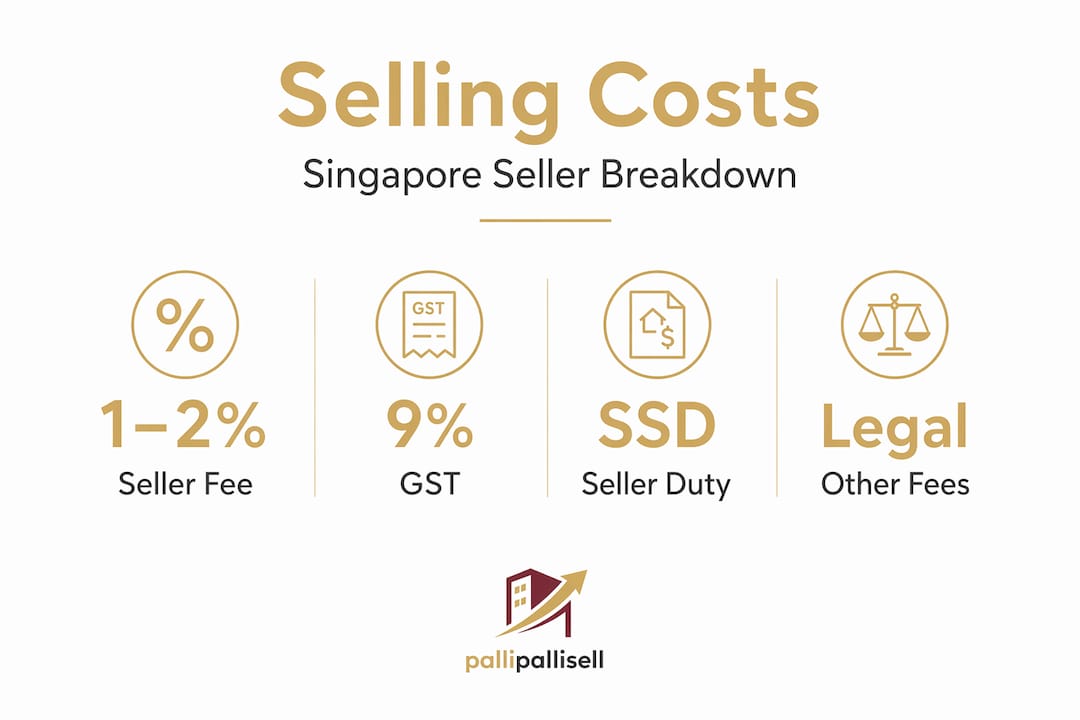
Commission is the largest single cost, but it’s not the only one. Here’s a realistic picture of what you’ll pay when selling a Singapore property.
Cost Item | Typical Range | Notes |
Seller commission | 1%–2% of sale price | Plus 9% GST if agent is GST-registered |
Legal conveyancing fees | S$2,000–S$3,000 | Payable to your property lawyer |
Seller Stamp Duty (SSD) | 4%–12% (if applicable) | Only applies if you sell within 3 years of purchase |
HDB upgrading levy | Varies | Applies to some resale transactions |
Agent admin/misc fees | Varies | Confirm in writing before signing |
Seller Stamp Duty is worth a specific mention. If you purchased your property within the last three years, SSD applies on a sliding scale, from 12% in the first year down to 4% in year three. It drops to zero after three years. This is separate from commission but affects your net proceeds significantly.
The commission amount directly reduces what you walk away with. On a S$700,000 flat with a 2% commission plus GST, your commission cost alone is S$15,260. Knowing this total before you list, not after, keeps your expectations accurate and your decisions clear.
My take on commission conversations in Singapore
I’ve seen sellers approach commission negotiations in two ways. Some treat it like an awkward topic they’d rather avoid. Others treat it like a straightforward business discussion. The second group consistently gets better outcomes.
What I find most sellers miss is the buyer agent incentive problem. When you cut your commission, you often cut the co-broke payout to buyer agents without realizing it. That affects whether agents actively bring their clients to your property or quietly steer them elsewhere. Cutting buyer agent fees too low is a real trade-off, and too few sellers factor it in when they negotiate.
My honest view: the agent model in Singapore is being reshaped by technology. Listing portals, digital valuation tools, and platforms that let sellers manage their own transactions are reducing the dependency on traditional full-service agents. The 2% standard was set in an era when agents were the primary source of buyer access. That’s no longer entirely true.
That said, I wouldn’t cut commissions to the bone without a plan to compensate. If you’re going low on agent fees, you need to invest in good photography, accurate pricing, and direct marketing reach. Sellers who cut cost without adding effort usually sit on the market longer than they expected.
If you’re considering selling your HDB or private property without an agent, the sell-without-agent guide at Pallipallisell is a practical starting point for understanding what that process actually involves.
— Brandon
Sell smarter with Pallipallisell
If paying S$12,000 or more in commission on your HDB sale sounds avoidable, it is. Pallipallisell is built for Singapore homeowners who want to take control of their property sale without writing a check to a traditional agent.
For a flat fee of just S$688, Pallipallisell gives you listing support, direct buyer access, and guidance through the transaction from start to close. You keep your proceeds. You stay in control. The affordable HDB selling options page breaks down exactly what’s included and what you save compared to a 1% or 2% agent commission. If you’re ready to list and want to see how the platform works, visit Pallipallisell’s property listings to get started. Thousands of dollars saved starts with one straightforward decision.
FAQ
What is the typical commission rate for selling an HDB flat in Singapore?
The standard seller-side commission for HDB resale is approximately 2% of the transaction price, plus 9% GST if the agent is GST-registered. On a S$600,000 flat, that amounts to S$12,000 in commission plus S$1,080 in GST.
Can you negotiate real estate agent fees in Singapore?
Yes. Commission rates in Singapore are not fixed by law. They follow CEA industry guidelines, which are benchmarks, not mandates. Sellers can and do negotiate lower rates, particularly on higher-value properties or straightforward sales.
What is a co-broke split in Singapore real estate?
A co-broke split is when the seller’s 2% commission is divided between the seller’s agent and the buyer’s agent, typically 1% each. This arrangement incentivizes buyer agents to show your property to their clients.
What happens if you offer a low or zero commission to buyer agents?
Offering very low or no buyer agent commission can reduce showing traffic because many buyers work through agents who are motivated by commission. Sellers who cut buyer-side fees should compensate with strong pricing and direct marketing to attract buyers independently.
What does a fixed-fee listing service include compared to a full-service agent?
A fixed-fee service typically covers listing support and buyer access at a set cost rather than a percentage of the sale price. Services like Pallipallisell offer this for S$688, compared to S$12,000 or more with a traditional 2% agent. You handle viewings and negotiation directly, keeping full control and maximizing your net proceeds.
Recommended


Comments