What Is an FSBO Property Sale? Singapore Guide

A FSBO property sale is defined as a transaction where the homeowner sells their property directly to a buyer without hiring a listing agent. FSBO stands for “For Sale By Owner,” and it is the recognized industry term for this type of private sale. Singapore homeowners choosing this route keep full control over pricing, marketing, negotiations, and paperwork. The primary draw is clear: you avoid paying a listing agent commission, which in Singapore typically ranges from 1% to 2% of the sale price. On a $1.5 million property, that saving alone can exceed $30,000.
What is an FSBO property sale and how does it work?
An FSBO sale places every responsibility that an agent would normally handle directly onto you, the seller. You set the price, photograph the property, write the listing, respond to inquiries, conduct viewings, negotiate offers, and manage the legal closing. That is a significant workload, but it is entirely manageable with the right preparation.
The core difference between FSBO and a traditional agent-assisted sale is who does the work and who earns the commission. In a conventional sale, the listing agent earns a commission from the sale proceeds. In an FSBO sale, you eliminate that fee. FSBO is more than posting a sign outside your door. It is a structured business transaction requiring project management, legal review, and skilled negotiation.
Singapore homeowners selling private residential property or HDB flats through FSBO must still comply with all Housing and Development Board regulations, stamp duty requirements, and conveyancing rules. The legal framework does not change because you removed the agent. What changes is who coordinates compliance.

Do the financial trade-offs of FSBO actually favor the seller?
The financial case for FSBO looks strong on paper. You save the listing agent commission. But the full picture is more nuanced.
Agent-assisted homes sell for a median price of $405,000 compared to $310,000 for FSBO homes, based on 2023 data. That is a significant gap. It reflects the pricing expertise, negotiation skills, and buyer network that agents bring to a transaction. In Singapore’s competitive property market, reaching qualified buyers quickly can directly affect your final sale price.
There is a second cost that surprises many FSBO sellers. Most FSBO sellers still pay the buyer’s agent commission, typically 2.5% to 3%, to attract agents who represent buyers. Skipping this fee drastically reduces your qualified buyer pool. So the actual saving in many cases is only the listing agent’s side of the commission.
Cost Factor | Agent-Assisted Sale | FSBO Sale |
Listing agent commission | 1%–2% of sale price | $0 |
Buyer’s agent commission | 2.5%–3% of sale price | Often still paid |
Median sale price (2023 data) | $405,000 | $310,000 |
Time investment | Low (agent manages) | High (seller manages) |
Legal and admin costs | Included in commission | Paid separately |
Time spent on FSBO is also a real cost. Sellers often spend dozens of hours fielding inquiries, scheduling viewings, and handling paperwork. That time has financial value, and it can offset commission savings if the sale drags on.
Pro Tip: Calculate your net saving honestly. Subtract the buyer’s agent commission you plan to offer, any legal fees, and the value of your time. Compare that to the listing agent fee you would have paid. The gap may be smaller than you expect.
How to sell FSBO: a step-by-step process for Singapore homeowners
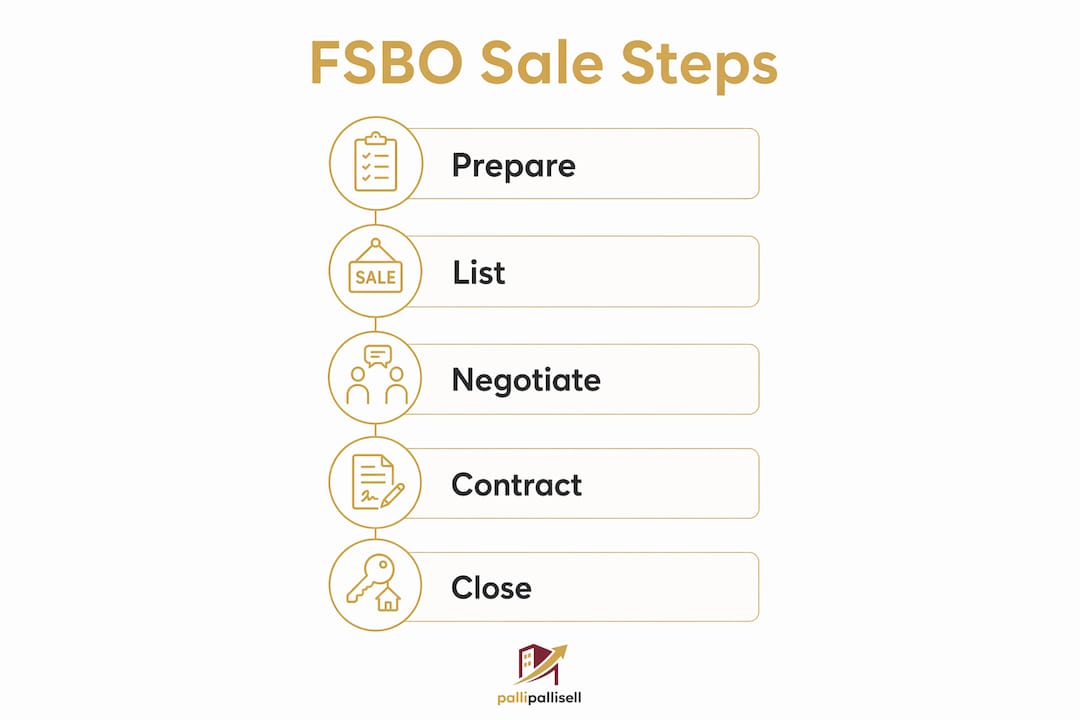
Successful FSBO sales follow a clear sequence of steps. Skipping any one of them creates problems later.
Research market prices. Pull recent transaction data for comparable properties in your area using URA’s REALIS portal or HDB’s resale flat prices database. Price your property based on facts, not sentiment.
Prepare and stage the property. Declutter every room. Fix visible defects. A clean, well-lit property photographs better and sells faster. Consider hiring a professional stager for larger private homes.
Commission professional photography. Clear, bright photos at eye level and from high angles show space accurately. Poor photos are the single fastest way to lose a buyer’s interest online.
List on the right platforms. Singapore sellers can post on property portals and flat-fee listing services. Pallipallisell offers a fixed-fee listing option at $688, giving you direct access to buyers without a full commission structure. You can also learn how to sell without agent fees through detailed guides tailored to the Singapore market.
Manage inquiries and viewings. Respond to every inquiry within 24 hours. Slow responses signal disorganization and push buyers toward other listings. Schedule viewings at times that suit serious buyers, not just yourself.
Negotiate offers directly. Know your minimum acceptable price before any offer arrives. Stay calm and fact-based during negotiations. Emotional reactions to low offers cost sellers money.
Hire a conveyancing lawyer. Hiring a real estate attorney is the recommended safeguard for managing legal documentation and reducing risk. In Singapore, a licensed conveyancing lawyer prepares the Option to Purchase (OTP), the Sale and Purchase Agreement, and handles CPF and mortgage discharge coordination.
Complete the closing process. Notarized deeds and official recording are mandatory final steps that legally transfer ownership. Your conveyancing lawyer files the transfer with the Singapore Land Authority (SLA) and ensures all stamp duties are paid.
Pro Tip: Book your conveyancing lawyer before you accept any offer. Delays in legal preparation after an offer is signed can cause buyers to walk away.
What are the legal and disclosure requirements for FSBO sellers?
FSBO sellers must comply fully with the same disclosure laws and legal requirements that apply to agent-led sales. Removing the agent does not reduce your legal obligations. It increases your personal exposure if something goes wrong.
Private property FSBO legal requirements in Singapore include several non-negotiable duties:
Disclose material defects. You must inform buyers of known structural issues, water damage, pest infestations, or any defect that affects the property’s value or habitability.
Provide accurate property information. Floor area, tenure, outstanding loans, and any encumbrances must be stated correctly in the OTP and Sale and Purchase Agreement.
Comply with HDB resale rules. HDB flat sellers must meet Minimum Occupation Period (MOP) requirements and obtain HDB’s approval before completing the sale.
Handle CPF and mortgage discharge. If CPF funds were used to purchase the property, the CPF Board must be notified and the refund calculated correctly at closing.
Pay the correct stamp duties. Seller’s Stamp Duty (SSD) applies if you sell within a specified holding period. Miscalculating this creates legal and financial penalties.
Legal disclosure failures and contract errors expose FSBO sellers to post-sale litigation and financial penalties. A buyer who discovers an undisclosed defect after closing has legal grounds to pursue damages. The cost of that dispute far exceeds any commission you saved. Hire a conveyancing lawyer. It is not optional.
What are the biggest FSBO challenges and how do you avoid them?
Most FSBO sellers underestimate what the process actually demands. Understanding the common pitfalls before you start puts you ahead of most first-time FSBO sellers.
Overpricing from emotional attachment. Emotional pricing leads to stale listings and forced price reductions that ultimately lower your net profit. Use objective comparable sales data, not your personal estimate of what your home is worth.
Limited buyer reach. FSBO sellers face exposure gaps because they lack access to professional buyer networks and MLS-style databases. This leads to longer listing periods and weaker negotiating leverage. Listing on multiple portals and using a flat-fee service addresses this directly.
Negotiating against experienced buyer agents. Buyer agents negotiate property deals every week. You may negotiate one every several years. Know your numbers, stay unemotional, and do not make concessions without a clear reason.
Underestimating paperwork volume. The OTP, Sale and Purchase Agreement, HDB resale application, CPF refund forms, and SLA transfer documents all require accuracy. One error delays closing or voids the transaction.
Skipping professional help to save money. Sellers who avoid legal fees to maximize savings often create larger problems. A conveyancing lawyer’s fee is a small fraction of your sale price and protects you from post-sale claims.
Reviewing a list of common FSBO mistakes before you list is one of the most practical steps you can take. Sellers who know the pitfalls in advance avoid most of them.
Key Takeaways
An FSBO property sale saves on listing agent commission but requires the seller to manage pricing, marketing, legal compliance, and closing with the same rigor as a professional transaction.
Point | Details |
FSBO definition | The seller manages the entire sale without a listing agent to save on commission fees. |
Real financial saving | Subtract buyer’s agent commission and legal fees before assuming FSBO is cheaper. |
Legal duties unchanged | Disclosure requirements, stamp duties, and conveyancing rules apply equally to FSBO sellers. |
Biggest risk | Overpricing and limited buyer reach are the two most common causes of failed FSBO sales. |
Conveyancing lawyer | Hiring a licensed conveyancing lawyer is non-negotiable for a legally valid FSBO closing. |
When FSBO actually makes sense: a frank assessment
FSBO works best for a specific type of seller. You need time, organization, and a realistic view of your property’s market value. If you have all three, the process is genuinely manageable.
The sellers I have seen succeed with FSBO share a few traits. They price based on data, not emotion. They respond to buyers fast. They hire a conveyancing lawyer without hesitation. And they treat the sale like a business transaction, not a personal milestone.
Where I see FSBO struggle is in slower markets or when sellers have an inflated sense of their property’s value. A stale listing in Singapore’s market signals problems to buyers, and the longer a property sits, the more leverage shifts to the buyer. That is the opposite of what you want.
Singapore’s property market moves quickly when a listing is priced correctly and marketed well. If you have a pre-qualified buyer already interested, or if you are selling in a high-demand area, FSBO has a real advantage. If you are starting from scratch with no buyer leads and limited time, weigh the trade-offs carefully before committing.
The honest truth is that FSBO is not for everyone. But for prepared, motivated sellers, it is a legitimate and financially rewarding path.
— Brandon
Sell your property in Singapore without agent fees
Pallipallisell is built for Singapore homeowners who want to sell directly without paying a listing agent. The platform charges a fixed fee of $688, giving you a full property listing, direct buyer inquiries, and complete control over your sale.
Whether you are selling an HDB flat or a private home, Pallipallisell gives you the tools to list, communicate, and close without a commission eating into your proceeds. Visit the property listings page to post your property today, or go directly to the HDB FSBO service if you are selling an HDB flat. Thousands of Singapore homeowners have already chosen the direct route. You can too.
FAQ
What does FSBO mean in real estate?
FSBO stands for “For Sale By Owner.” It describes a property sale where the homeowner sells directly to a buyer without hiring a listing agent.
Is FSBO legal in Singapore?
Yes, FSBO is fully legal in Singapore. Sellers must still comply with HDB regulations, conveyancing law, stamp duty requirements, and all standard disclosure obligations.
Do FSBO sellers still need a lawyer in Singapore?
Yes. A licensed conveyancing lawyer prepares the Option to Purchase and Sale and Purchase Agreement, handles CPF and mortgage discharge, and files the ownership transfer with the Singapore Land Authority.
How does an FSBO sale differ from a traditional property sale?
The seller performs all tasks an agent would normally handle, including pricing, marketing, negotiations, and legal coordination. The key difference is that no listing agent commission is paid.
Can I sell my HDB flat through FSBO?
Yes, HDB flat owners can sell without an agent provided they meet the Minimum Occupation Period requirement and follow HDB’s resale procedures. Platforms like Pallipallisell offer HDB flat selling guidance tailored to this process.
Recommended


Comments