Why HDB Commission Fees Are So High in Singapore


If you’ve recently explored selling your HDB flat, you’ve likely asked yourself why HDB commission fees so high seem to be the unavoidable reality. The numbers can feel shocking. Sellers routinely pay 2% of the sale price, and with agent commissions being one of the largest non-stamp-duty costs in the transaction, many homeowners accept these fees without question. This article breaks down exactly where that money goes, why the fees are structured the way they are, and what you can do right now to pay less.
Table of Contents
Key Takeaways
Point | Details |
Fees are market conventions | HDB commission rates are not set by law; they are negotiable commercial arrangements between you and your agent. |
Seller pays more than buyer | Sellers typically pay 2% plus GST while buyers pay 1% plus GST, making seller costs significantly higher. |
Agent costs drive up fees | Marketing expenses, portal listings, and co-broke arrangements all contribute to the reason for high HDB fees. |
Negotiation is always possible | Especially for high-value flats, you can negotiate flat fees or reduced percentages and save thousands. |
Fixed-fee platforms exist | Tech-driven alternatives offer significantly lower HDB selling costs without sacrificing the core selling process. |
Why HDB commission fees feel so high
Let’s be direct. For a S$700,000 HDB resale flat, the seller pays around S$15,260 in commission alone once you add the 2% seller fee plus 9% GST. The buyer pays roughly S$7,630 on top of that. These figures are not small. When you add legal fees, stamp duties, and other administrative costs, the HDB fees breakdown can feel overwhelming.
What surprises most homeowners is that these rates are not written into any law. There is no government regulation that says sellers must pay 2%. These are market conventions, habits reinforced by decades of practice in Singapore’s property industry. Agents charge these rates because sellers have historically accepted them. And because most people only sell one or two properties in a lifetime, very few know to push back.
The confusion between market norms and statutory rules is real. Many sellers assume the 2% is fixed, non-negotiable, and required. It is none of those things. Understanding that distinction is the starting point for taking control of your HDB selling costs.
What the standard HDB fees breakdown looks like
Here is how HDB commission rates typically break down in a standard resale transaction:
Party | Commission Rate | GST (if applicable) | Example on S$700,000 flat |
Seller | 2% of sale price | +9% | S$15,260 |
Buyer | 1% of purchase price | +9% | S$7,630 |
Total transaction cost | 3% combined | — | S$22,890 |
The buyer’s agent commission is disclosed in the Customer’s Agreement and is paid separately by the buyer, not the seller. That said, in some deals, sellers are asked to cover both sides. Always check your agreement carefully.
GST applies only if the agency is GST-registered. But most established agencies are, so you should assume GST will apply. That 9% addition meaningfully increases what you actually pay beyond the headline percentage.
The CEA Code of Practice requires agents to disclose all commission rates in writing through a Customer’s Agreement before any work begins. This is your legal protection. If an agent cannot produce a clear written agreement before you sign anything, that is a red flag.
Pro Tip: Always request the Customer’s Agreement upfront and read every line related to commissions, co-broke splits, and GST. Vague agreements are where overpayment hides.
Why agent fees stay high
There are real cost pressures agents face. But there are also inherited habits that have little to do with the value delivered to you. Understanding both helps you negotiate from an informed position.
Portal marketing costs: Agents pay significant sums to appear on the first page of Singapore’s major property portals. Premium placement on platforms like PropertyGuru or 99.co is not cheap, and agents pass those costs through to sellers via commission.
Historical gatekeeping: Agents were once the only way to access listings, market data, and buyer connections. That information edge has largely eroded in the digital age, but the pricing model has not caught up.
Co-broke arrangements: When your listing agent shares commission with a buyer’s agent, the split reduces what each party earns. To protect their own income, some agents set higher starting rates to compensate for this split.
Hard-to-sell units: Higher-priced or difficult properties may genuinely require more work, more ad spending, and longer timelines. Agents justify higher fees for these cases, sometimes reasonably.
GST compounding: Even at the standard 2%, GST adds another 9% on top of that figure. On a S$1 million flat, you are looking at S$21,800 in commission before any other transaction cost.
The key insight here is that much of what inflates the HDB agent commission is not purely agent skill or time. A portion of it is the agent’s own business overhead, passed directly to you as the seller. Knowing this gives you grounds to ask questions.
Pro Tip: Ask your agent to itemize their marketing plan and estimated ad spend before you agree to any fee. A good agent will have clear answers. Vague answers may signal you are paying for overhead you will not benefit from.

How to reduce what you pay
Commission fees are commercial and negotiable, full stop. Here is how to approach the conversation:
Start by benchmarking the market. Research what agents in your area charge and what comparable flats have sold for recently. The HDB commission rate breakdown for 2026 is a useful starting point to understand current norms before entering any negotiation.
Request a flat fee instead of a percentage. For a S$900,000 flat, a flat fee of S$10,000 is 1.1%. At 2%, you would pay S$18,000. That S$8,000 difference is real money you keep in your pocket.
Leverage your flat’s appeal. Well-located, well-maintained flats with strong buyer demand require less agent effort. Use that as leverage. Agents want easy commissions. A desirable flat is exactly that.
Ask for a reduced rate on high-value transactions. Sellers of million-dollar flats routinely negotiate rates down to 1.5% or lower. The higher the absolute dollar amount, the more room there is to negotiate.
Consider fixed-fee or tech platforms. Tech-driven platforms now offer fixed 1% agent fees, saving sellers S$5,000 to S$15,000 compared to traditional rates. For homeowners who are comfortable managing some parts of the process themselves, this is a compelling option.
Explore selling without an agent. Platforms designed for selling without agent fees give you control over the listing, buyer communication, and negotiation. You handle more of the work, but you keep significantly more of the proceeds.
Comparing your selling options
Choosing the right approach depends on how much time you have, how comfortable you are managing the process, and how much you want to save. Here is a clear comparison:
Selling Method | Typical Cost | Effort Required | Personalized Support | Risk Level |
Traditional agent | 2% + GST | Low for seller | High | Low |
Fixed-fee platform | Fixed S$688 to S$2,000 | Medium | Moderate | Low-Medium |
Tech-assisted 1% agent | ~1% + GST | Medium-Low | Moderate | Low |
Full DIY | S$0 commission | High | None | Medium-High |
Traditional agents offer the most hand-holding. But that comfort comes at a price that is, in most cases, negotiable or replaceable. The key advantage of a traditional agent is speed in a slow market or for a complex unit. For straightforward transactions in a healthy market, you are largely paying a premium for convenience.
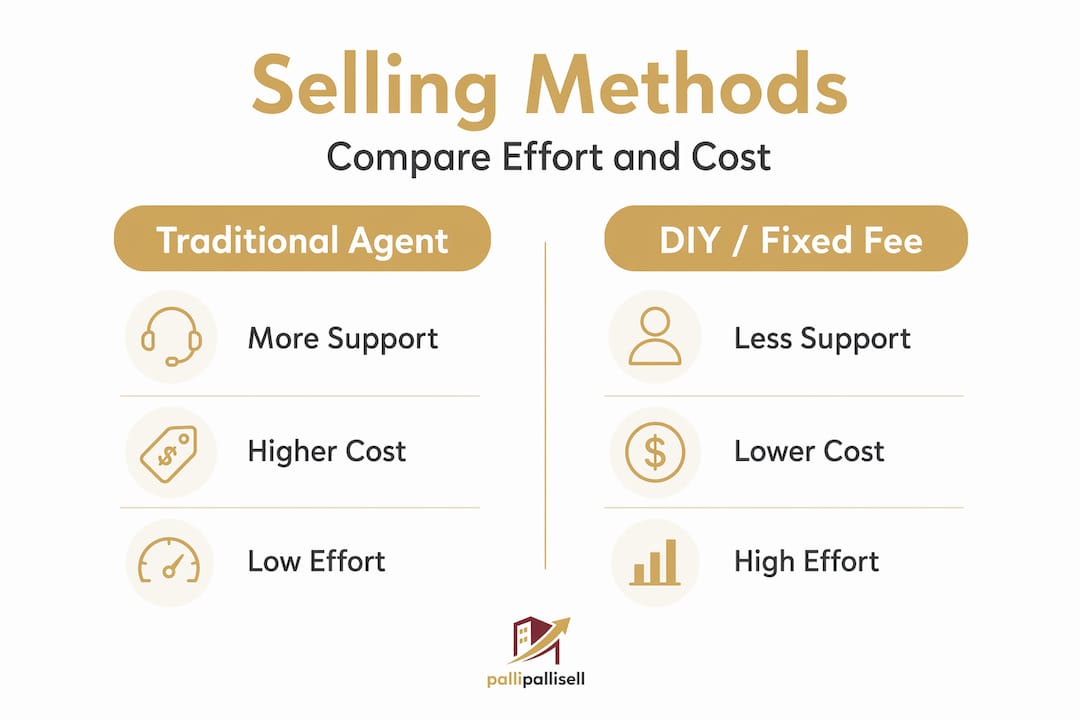
Fixed-fee platforms sit in the middle. You get listing support, buyer inquiries, and guidance through the paperwork, but without the percentage-based commission eating into your sale. DIY or tech-supported selling requires real effort from sellers, including handling viewings, marketing, and all administrative steps. The savings can be substantial. However, the effort is frequently underestimated. Go in with a realistic understanding of what you are taking on.
Here are scenarios where each option works best:
Traditional agent: Your unit is unique, you have limited time, or the market is slow.
Fixed-fee platform: You are comfortable communicating with buyers and understand the basics of HDB paperwork.
Full DIY: You have sold property before, understand the legal process, and have time to manage viewings and offers.
How to protect yourself from overpaying
Sellers frequently overpay by S$15,000 or more simply because they do not ask the right questions. Here is what to do before you sign anything:
Verify your agent’s CEA registration number at the CEA public register. Do not work with unregistered agents or those who cannot produce their registration details immediately.
Read the Customer’s Agreement in full. Pay close attention to the commission clause, GST terms, and any marketing cost provisions.
Ask about dual representation. The CEA prohibits dual representation without written consent from both parties. If your agent is also representing the buyer, you must be informed and agree in writing.
Compare at least three agents. Fee differences between agents for the same property can be significant. A quick round of comparisons puts you in a stronger negotiating position.
Clarify when payment is due. Commission is typically paid at completion. Confirm this in writing and ask whether any portion is refundable if the deal falls through.
Pro Tip: Negotiate a rebate clause into your agreement. Some agents will agree to return a portion of the commission if the property sells above a target price or within a short timeframe. This aligns their incentive with yours.
Understanding what no-commission property selling means in practical terms is also worth your time. It is not just about saving money. It is about having full visibility into every dollar of your transaction.
My honest take on this
I’ve watched too many sellers hand over S$15,000 or more to agents without asking a single question. Not because those sellers were naive. Because the system is designed to make the fee feel routine. And routine feels non-negotiable.
In my experience, the homeowners who negotiate best are the ones who come to the conversation informed. Not aggressive, not confrontational. Just prepared. They know the market rate, they understand what the agent is actually doing for that fee, and they have alternatives ready. That combination works. I’ve seen sellers on standard three-room and four-room flats walk away with fees closer to 1% or flat arrangements that saved them S$8,000 or more.
The uncomfortable truth is that the high commission model faces disruption from fixed-fee platforms, and agents know it. The market is shifting. Sellers who act on that knowledge now benefit the most. Five years from now, I expect the standard rate will feel as outdated as paying a travel agent to book a flight. The tools to do it yourself, or with minimal support, already exist. Use them.
— Brandon
Save on HDB selling fees with Pallipallisell
If this article has made one thing clear, it’s that high HDB commission fees are not mandatory. You have options.
Pallipallisell is built for homeowners who want to sell their HDB flat without overpaying. The platform offers a low fixed fee of S$688, giving you full control over your listing, direct communication with buyers, and a transparent process from start to finish. There are no percentage-based commissions eating into your proceeds. If you are ready to explore what selling looks like without the traditional markup, visit the sell HDB without agent page and see exactly how it works. You keep more of what your flat is worth.
FAQ
What is the typical HDB agent commission rate in Singapore?
The standard HDB commission rate is 2% of the sale price for sellers and 1% for buyers, with 9% GST added if the agency is GST-registered. For a S$700,000 flat, that means a seller pays approximately S$15,260.
Are HDB commission fees fixed by law?
No. HDB commission rates are market conventions, not legal requirements. All rates are negotiable, and sellers should discuss and confirm fees in writing before engaging any agent.
How can I reduce my HDB selling costs?
You can negotiate a lower percentage, request a flat fee, use a fixed-fee platform like Pallipallisell, or sell your flat directly without an agent. Comparing multiple agents and understanding what services are included helps you negotiate effectively.
What does the CEA require agents to disclose about commissions?
The CEA Code of Practice requires agents to provide a written Customer’s Agreement that clearly states all commission rates and terms before any transaction begins. Dual representation is also prohibited without written consent from all parties.
Can I sell my HDB flat without paying any agent commission?
Yes. Platforms designed for HDB sellers without agents allow you to list, communicate with buyers, and close the transaction yourself. You will need to manage viewings and paperwork, but the commission saving can exceed S$15,000 on a typical flat.
Recommended


Comments