HDB Resale Levy Explained: 2026 Singapore Guide
- Pallipallisell

- Jul 4
- 8 min read
The HDB resale levy is a fixed-sum charge paid when you buy a second subsidized flat or new Executive Condominium (EC) after selling your first subsidized HDB flat in Singapore. Understanding what is HDB resale levy means knowing it is not a tax. It is a subsidy recovery tool designed to keep Singapore’s public housing system fair for all buyers. The Housing & Development Board (HDB) and CPF Board administer this policy together, and the amounts have stayed fixed since the 2006 reform. If you are planning a second flat purchase, this levy will affect your budget directly.
What is the HDB resale levy and how much do you pay?
The levy amounts are fixed by the size of your first subsidized flat, not by the price you sell it for. That distinction matters because many buyers expect a percentage-based charge and are caught off guard by the flat sums involved.
The standard levy amounts by flat type are:
2-room flat: S$15,000
3-room flat: S$30,000
4-room flat: S$40,000
5-room flat: S$45,000
Executive flat: S$50,000
Executive Condominium: S$55,000
Singles who used the Single Singapore Citizen (SSC) grant for their first flat pay half the standard levy when buying a second subsidized flat. That discount does not apply when the second purchase is an Executive Condominium. Full levy applies to ECs regardless of prior grant usage.
Pro Tip: Check your first flat’s flat type carefully before budgeting. A 3-room flat triggers a S$30,000 levy, but an executive flat triggers S$50,000. The difference is significant for your cash planning.

Legacy rules also apply to some owners. If you purchased your first flat before the current fixed-sum system took effect in 2006, or if you received a CPF housing grant on a resale flat before that year, a capped legacy levy may apply. That cap can reduce your obligation compared to today’s standard amounts.
How and when must the resale levy be paid?
Payment rules for the HDB resale levy are strict. The levy must be paid in full at legal completion of your new flat purchase, before you collect your keys. There are no installment options.
Two payment sources are accepted:
Cash: Paid directly at completion
Sale proceeds from your first flat: Deducted before CPF funds are returned to you
Two sources are explicitly not accepted:
CPF Ordinary Account (OA) funds
Bank loan or HDB loan proceeds
The timing of your sale and purchase creates a real cash flow risk. If your new flat purchase completes before your old flat is sold, you must pay the levy in cash upfront. That cash is only reimbursed from your sale proceeds later. This gap can run into tens of thousands of dollars and directly competes with renovation costs and stamp duties.
Pro Tip: Plan your sale timeline before committing to a new flat purchase. If your old flat sells first, the levy comes out of proceeds automatically. If the new purchase completes first, you need that cash ready on completion day.
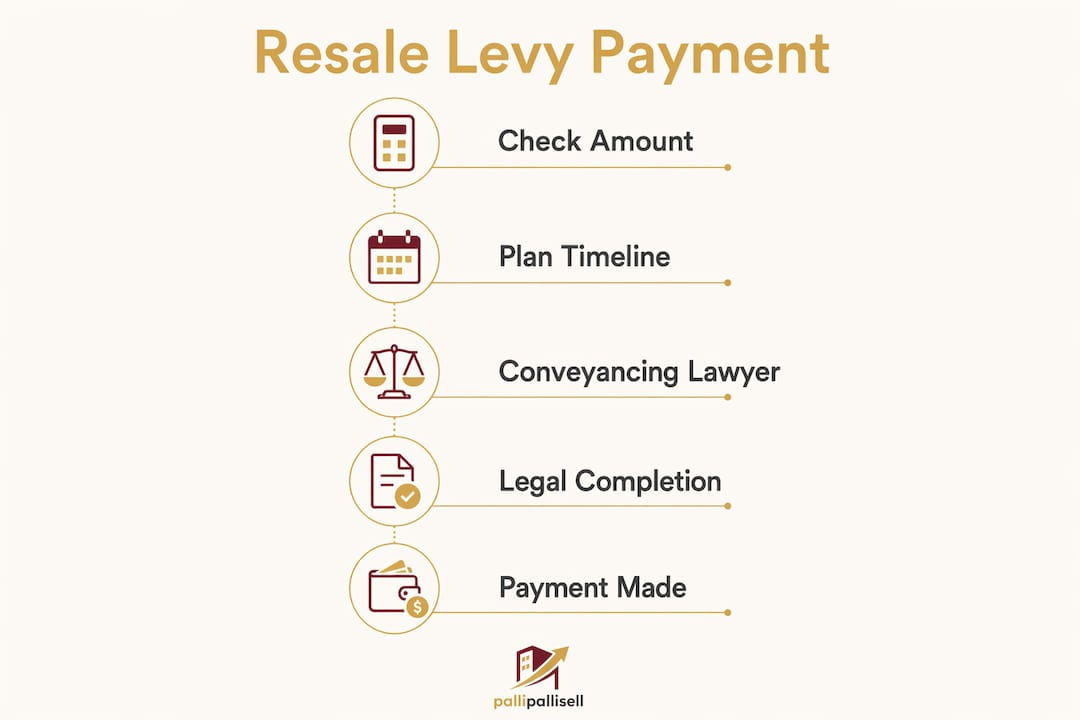
Your conveyancing lawyer handles the actual levy payment at legal completion. Confirm the exact amount with HDB early in the process so your lawyer can prepare the correct funds. Do not leave this to the last week before key collection.
Are there ways to avoid paying the resale levy?
The resale levy does not apply in every second-purchase scenario. Knowing when it is triggered and when it is not gives you real options.
The levy only applies when you buy a new subsidized flat directly from HDB or a new EC from a developer, after previously receiving a housing subsidy. Buying a resale flat on the open market does not trigger the levy, regardless of your ownership history.
Here are the main situations where the levy does not apply:
You buy a resale flat on the open market. No levy is charged. You may still qualify for CPF housing grants depending on your household income and other criteria.
You have never received a housing subsidy. If your first flat was a resale flat purchased without any CPF housing grant, no levy applies to your next purchase.
You are a first-time buyer. The levy only affects second-timers who previously received a subsidy.
You buy private property. The levy is specific to subsidized HDB and EC purchases.
For second-timers who want a new flat but want to reduce costs, the open market route is the most practical legal option. You skip the levy entirely and still access a wide range of flat sizes and locations. The trade-off is that new BTO flats often come at lower prices and with longer lease terms, so weigh that carefully.
Understanding the full HDB resale process helps you time your sale and purchase to minimize financial pressure. You can also review hidden fees in property transactions to see how the levy fits into your total transaction cost picture.
What financial impact does the resale levy have on buyers?
The levy functions as a subsidy recovery mechanism. It is not an additional tax but a reduction in the net subsidy you receive over your lifetime as an HDB buyer. That framing matters because it changes how you should think about it in your budget.
The practical financial effects are significant:
Reduced sale proceeds: The levy is deducted from your first flat’s sale proceeds before CPF funds are returned to your account.
Cash flow pressure: If your new purchase completes before your sale, you need to fund the levy from personal savings.
Renovation budget competition: A S$40,000 levy on a 4-room flat competes directly with renovation costs, which can easily reach similar amounts.
Stamp duty stacking: Buyer’s Stamp Duty and Additional Buyer’s Stamp Duty (ABSD) may also apply, adding further pressure on available funds.
The levy deduction happens before CPF refunds are processed. That sequence means your CPF account receives less than you might expect from the sale, and your cash position on completion day must account for the full levy amount if your timelines do not align.
Calculate your levy amount the moment you decide to buy a second subsidized flat. Factor it into your total purchase budget alongside stamp duties, legal fees, and renovation costs. Sellers who understand what costs eat into HDB sale profit are better positioned to plan accurately and avoid shortfalls.
Common misconceptions about the HDB resale levy
Several misunderstandings about the levy circulate among buyers. Clearing them up saves you from costly planning errors.
“The levy applies to all resale flat purchases.” False. The levy only applies when buying new subsidized flats directly from HDB or developers. Open market resale purchases are exempt.
“The levy is a tax.” Incorrect. The levy is a subsidy adjustment, not a government tax. It reduces the net lifetime subsidy you receive, not your taxable income.
“You can appeal for a full waiver.” HDB does not grant full waivers. Partial waivers have been approved in roughly one-third of appeals, and only in genuine hardship cases. Do not plan your finances around a waiver being granted.
“Singles always pay half the levy.” Only singles who used the SSC grant on their first flat pay half. Singles who did not use that grant pay the full amount. And no discount applies when buying an EC.
“The levy amount changes with property prices.” The levy has been a fixed sum since 2006. It does not adjust for inflation or market conditions.
“The levy and ABSD are the same thing.” They are separate charges. ABSD applies based on citizenship status and number of properties owned. The resale levy applies based on prior subsidy history. Both may apply simultaneously.
Understanding these distinctions protects you from budgeting errors. Review the HDB selling fees guide to see how the levy sits alongside other unavoidable costs.
Key Takeaways
The HDB resale levy is a fixed, non-negotiable charge that reduces your lifetime subsidy allocation and must be paid in cash or from sale proceeds before key collection.
Point | Details |
Fixed levy amounts | Levy ranges from S$15,000 for a 2-room flat to S$55,000 for an Executive Condominium. |
Payment method is strict | Pay only in cash or from sale proceeds. CPF OA funds and loan proceeds are not accepted. |
Open market avoidance | Buying a resale flat on the open market legally avoids the levy entirely. |
Singles get a discount | Singles who used the SSC grant pay half the levy, except when buying an Executive Condominium. |
Plan your timeline early | If your new flat completes before your sale, you must fund the levy from personal cash savings. |
Why the resale levy catches buyers off guard every time
Most buyers I speak with understand that a second flat costs more. What surprises them is the mechanics. The levy does not show up as a line item during flat selection. It surfaces at legal completion, when your cash position is already stretched by stamp duties and renovation deposits.
The buyers who handle it best are the ones who calculate the levy amount on day one, not day ninety. If you know your first flat was a 4-room, you know S$40,000 is coming out of your proceeds or your savings. You plan around it. You do not discover it two weeks before key collection.
My honest observation is that the open market route is underused by second-timers. Many buyers fixate on new BTO flats because of the lower purchase price, but they do not subtract the levy from that calculation. A resale flat with no levy, combined with CPF housing grants where eligible, can produce a better net outcome than a BTO flat with a S$45,000 levy attached.
The legacy rules are also worth checking if your first flat purchase predates 2006. I have seen buyers assume they owe the full current amount when their actual obligation is lower under the capped legacy formula. Verify your specific situation with HDB directly before finalizing your budget.
Seek clarity early. Use official HDB resources, get your conveyancing lawyer involved before the option to purchase stage, and calculate the levy into your total cost from the start.
— Brandon
Selling your HDB flat? Pallipallisell makes it straightforward
Understanding the resale levy is one part of the equation. Maximizing what you keep from your sale is the other.
Pallipallisell is a digital platform built for Singapore homeowners who want to sell HDB without an agent and keep more of their sale proceeds. Instead of paying agent commissions of 1%–2%, you pay a flat fee of $688. That saving directly offsets costs like the resale levy. You list your property, communicate with buyers, and close the deal on your terms. Browse current property listings to see what is available, or list your own flat and take control of your transaction today.
FAQ
What is the HDB resale levy in simple terms?
The HDB resale levy is a fixed charge paid when you buy a second subsidized HDB flat or new Executive Condominium after selling your first subsidized flat. It is a subsidy recovery mechanism, not a tax.
Who is required to pay the HDB resale levy?
Second-time buyers who previously received a housing subsidy on their first HDB flat must pay the levy when purchasing a new subsidized flat or EC directly from HDB or a developer.
Can you avoid the HDB resale levy legally?
Yes. Buying a resale flat on the open market does not trigger the levy, regardless of your prior subsidy history. This is the most common legal way to avoid the charge.
Does the resale levy apply to Executive Condominiums?
Yes. The levy for an EC is S$55,000, the highest fixed amount in the schedule. Singles who used the SSC grant do not receive the half-levy discount when buying an EC.
Can HDB waive the resale levy?
HDB does not grant full waivers. Partial waivers have been approved in roughly one-third of hardship appeals, but they are exceptions. Do not factor a waiver into your financial plan.
Recommended


Comments