Singapore Property Ownership Rights Explained for 2026

Singapore property ownership rights are defined by a registered land title system governed by the Land Titles Act and administered by the Singapore Land Authority (SLA). This system determines who legally owns a property, what protections they hold, and what restrictions apply. Whether you own an HDB flat or a private home, your legal rights begin at registration, not at signing a contract. Understanding these rights protects you from costly mistakes and helps you plan smarter for the future.
How does the Torrens system establish property ownership in Singapore?
The Torrens system is the legal foundation of Singapore real estate ownership. Under this system, registration creates title. A signed contract alone does not make you the legal owner of a property.
The Land Titles Act makes this clear. Instruments are ineffectual until registered, and the registered proprietor’s estate is paramount over all competing claims. Priority between competing interests is determined by the order of registration, not the order of signing.
This system gives registered owners a powerful protection called indefeasibility of title. Under the Land Titles Act, registration protects owners from prior unregistered claims and eliminates the risk of adverse possession. No one can claim your property simply by occupying it over time.
Here is what the Torrens system means in practice:
The SLA maintains the Land Register as the conclusive record of ownership.
You can search property records through the IRAS portal for $2.50 per inquiry.
A caveat filed after your Sale and Purchase Agreement protects your interest while registration is pending.
Failing to lodge a caveat leaves buyers exposed to competing registered interests.
Transfer of ownership is only complete when the new owner is registered at SLA.
One important nuance: physical land ownership in Singapore has limits. Ownership extends only to 30 meters below Singapore Height Datum. Subterranean rights deeper than that belong to the State. Airspace ownership is similarly limited to the height needed for ordinary use and enjoyment.
Pro Tip: File your caveat immediately after signing your Sale and Purchase Agreement. Do not wait for completion. A caveat puts the world on notice of your interest and protects you if a competing claim is registered before your transfer completes.
You can learn more about how title registration works in the Singapore property title guide published by Pallipallisell.
What are the co-ownership structures and how do they affect inheritance?
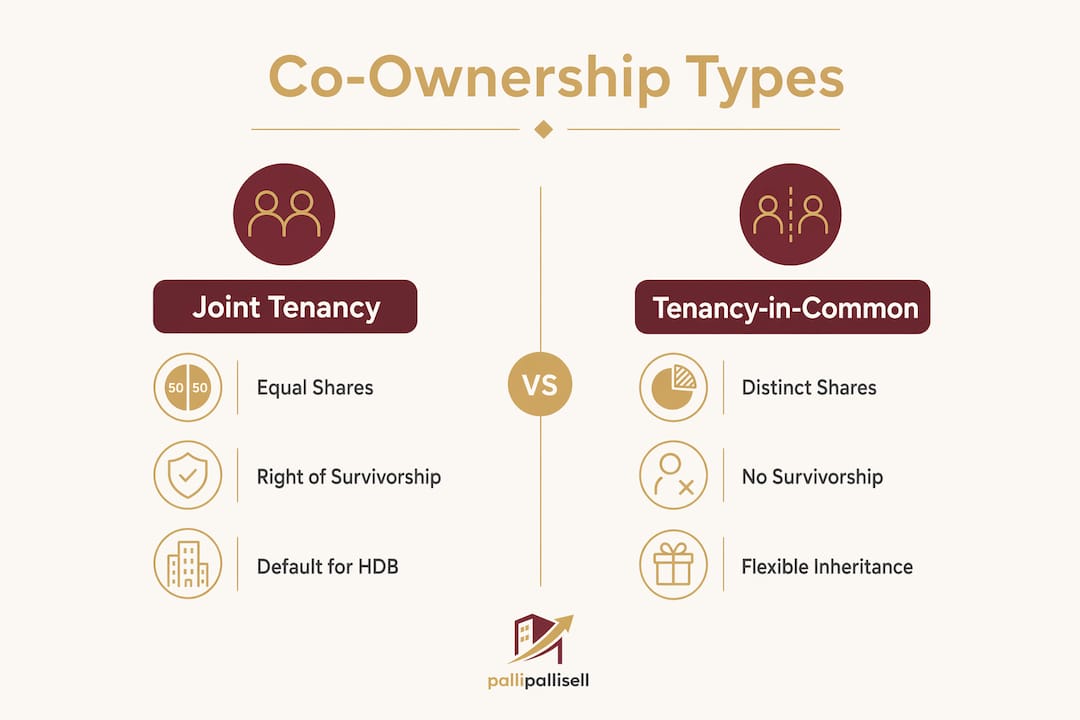
Co-ownership in Singapore takes two forms: Joint Tenancy and Tenancy-in-Common. They look similar on the surface but carry very different legal consequences, especially for inheritance.
Feature | Joint Tenancy | Tenancy-in-Common |
Ownership shares | Equal, undivided | Distinct fractional shares |
Right of survivorship | Yes, automatic | No |
Will applies to property | No | Yes |
Probate required on death | No | Yes |
Common use | HDB flats (married couples) | Investment properties, unequal contributions |

Under Joint Tenancy, the right of survivorship automatically vests the deceased owner’s share in the surviving joint tenant. No will, no probate, no delay. The surviving owner simply registers the death certificate with SLA and the title updates.
Tenancy-in-Common works differently. Each owner holds a defined share, say 60% and 40%. When one owner dies, their share passes according to their will or, if there is no will, under the Intestate Succession Act. This requires probate, which takes time and money.
Joint Tenancy is the default for HDB flats purchased by married couples. Private property buyers can choose either structure at the point of purchase.
Estate planning is where many families make a critical error. Many families overlook the right of survivorship implications in Joint Tenancy. If you hold a property as a joint tenant and want to leave your share to your children rather than your spouse, your will cannot override the survivorship rule. Couples often switch to Tenancy-in-Common later to fix this.
CPF contributions on jointly owned property also depend on ownership type. The CPF refund obligations on sale differ between Joint Tenancy and Tenancy-in-Common, affecting how sale proceeds are distributed.
Pro Tip: Review your co-ownership structure before finalizing any estate plan. Switching from Joint Tenancy to Tenancy-in-Common requires a severance of joint tenancy, which is a straightforward legal process but must be done before death to take effect.
What are the ownership restrictions for foreigners and permanent residents?
Singapore’s home ownership regulations draw a sharp line between citizens, permanent residents (PRs), and foreigners. The Residential Property Act governs these distinctions, and the rules are strictest for landed residential property.
Landed property accounts for only about 5% of Singapore’s residential housing stock. The government protects this limited supply through tight ownership controls.
The key rules are:
Singapore citizens can purchase any type of residential property, including landed homes, without restriction.
Permanent residents require approval from the Land Dealings Approval Unit (LDAU) to buy mainland landed property. Approval is generally considered for PRs with five or more years of residence and a demonstrated economic contribution to Singapore.
Foreigners face the strictest rules. Standard LDAU approval is rarely granted to foreign nationals for landed residential property.
Sentosa Cove is the main exception. Foreigners can purchase landed homes in Sentosa Cove with LDAU approval, and the process there is more accessible.
Condominiums and apartments remain open to foreigners, subject to Additional Buyer’s Stamp Duty (ABSD) rates.
If you are a PR or foreigner interested in landed property, the LDAU approval process requires a formal application and supporting documentation. Approval is discretionary and not guaranteed.
The practical takeaway: foreigners and PRs should focus their Singapore real estate ownership on non-landed private residential properties unless they meet the specific criteria for LDAU approval.
How does property ownership differ between HDB flats and private homes?
HDB flats and private residential homes operate under different rules. Knowing the difference protects you from compliance issues and unexpected costs.
Tenure type. HDB flats are almost exclusively leasehold, typically on 99-year leases from the state. Private homes can be leasehold (99 or 999 years) or freehold. Fee simple is the highest form of estate in Singapore land law, giving freehold owners the most complete ownership rights.
Co-ownership defaults. HDB flats purchased by married couples default to Joint Tenancy. Private property buyers choose their co-ownership structure at purchase.
Transfer restrictions. HDB flats carry a Minimum Occupation Period (MOP) of five years before you can sell on the open market. Private homes have no equivalent restriction.
Subletting rules. HDB owners must apply to HDB for approval to sublet their flat. Private homeowners can sublet without HDB approval, though other regulations apply.
Legal title registration. Both HDB and private property ownership is confirmed through registration with SLA. The Torrens system applies equally to both. Your title deed is the registered entry in the Land Register, not the physical document you hold.
The most important practical point: a common buyer mistake is confusing the Sale and Purchase Agreement with legal ownership. Signing the agreement gives you a contractual right. Registration at SLA gives you the legal title. These are not the same thing.
Key Takeaways
Singapore property ownership rights are secured through registration under the Land Titles Act, not through contracts, and the structure of co-ownership you choose directly shapes your inheritance outcomes and financial obligations.
Point | Details |
Registration creates title | Signing a contract does not make you the legal owner. SLA registration is the legal act that transfers title. |
Indefeasibility protects owners | Registered owners are shielded from prior unregistered claims and adverse possession under the Land Titles Act. |
Co-ownership type affects inheritance | Joint Tenancy bypasses probate via survivorship; Tenancy-in-Common allows testamentary disposition of shares. |
Foreigners face landed property limits | PRs and foreigners need LDAU approval for landed homes, and approval for foreigners is rarely granted. |
HDB and private homes have different rules | HDB flats carry MOP restrictions and subletting approval requirements that private homes do not. |
Why I think most buyers underestimate the registration step
Most buyers focus on price, location, and financing. Registration is treated as an administrative formality. That is a mistake I have seen cost buyers dearly.
The Torrens system is elegant in its logic: whoever registers first wins. That means the window between signing your Sale and Purchase Agreement and completing registration is a period of real legal exposure. Filing a caveat immediately after signing is not optional caution. It is basic protection.
The co-ownership question deserves equal attention. Couples buying their first HDB flat rarely think about what happens if one partner dies unexpectedly. Joint Tenancy solves the probate problem but removes your ability to direct your share by will. That trade-off is worth a deliberate conversation before you sign, not after.
Foreign buyers often focus on what they can purchase rather than what they legally own after purchase. Buying a condominium unit is straightforward. But understanding that your airspace rights are limited and your subterranean rights below 30 meters belong to the State adds important context to what “ownership” actually means in Singapore.
My consistent advice: treat the legal structure of your purchase with the same seriousness you give the price negotiation. The financial stakes are identical.
— Brandon
Pallipallisell can help you sell with full clarity
Understanding your ownership rights is the first step. Knowing how to act on them is the next.
Pallipallisell helps Singapore homeowners sell their HDB flats and private properties directly, without paying agent commissions that typically run 1% to 2% of the sale price. The platform charges a fixed fee of $688, giving you full control over your listing, negotiation, and closing. Check the HDB selling fee details to see exactly what you pay. You can also sell your HDB without an agent and keep more of your sale proceeds. Browse current property listings to see what buyers are looking for right now.
FAQ
What is the Torrens system in Singapore property law?
The Torrens system is Singapore’s land registration framework under the Land Titles Act. Registration at SLA is the legal act that creates and transfers title, making the Land Register the conclusive proof of ownership.
Does signing a Sale and Purchase Agreement make you the legal owner?
No. Signing the agreement gives you a contractual right to the property. Legal ownership is only confirmed when the transfer is registered with the Singapore Land Authority.
Can foreigners buy landed property in Singapore?
Foreigners can buy landed property only with LDAU approval, which is rarely granted for mainland properties. Sentosa Cove landed homes are the main exception where approval is more accessible.
What is the difference between Joint Tenancy and Tenancy-in-Common?
Joint Tenancy gives equal shares with automatic survivorship on death, bypassing probate. Tenancy-in-Common gives distinct fractional shares that pass by will or the Intestate Succession Act.
What are the main restrictions on HDB flat ownership?
HDB flat owners must complete a five-year Minimum Occupation Period before selling on the open market and must obtain HDB approval before subletting their flat.
Recommended


Comments