Why Agents Charge 2 Percent on Property Sales


A 2% property agent commission is defined as the listing fee paid to a seller’s agent, calculated as 2% of the final sale price. In Singapore, this rate has become a common benchmark for residential property sales, covering HDB flats and private homes alike. The average total commission sits around 5.7% when both the listing agent and buyer’s agent are included. That means the 2% figure applies only to one side of the transaction, not the full cost. Understanding why agents charge 2 percent on property sales helps you negotiate with confidence and avoid paying more than necessary.
Why do agents charge 2 percent on property sales?
The 2% commission rate reflects a balance between competitive market pricing and the real cost of running a professional real estate practice. Agents do not set this number arbitrarily. It covers marketing expenses, administrative work, legal coordination, and the time spent managing viewings, negotiations, and paperwork from listing to closing.
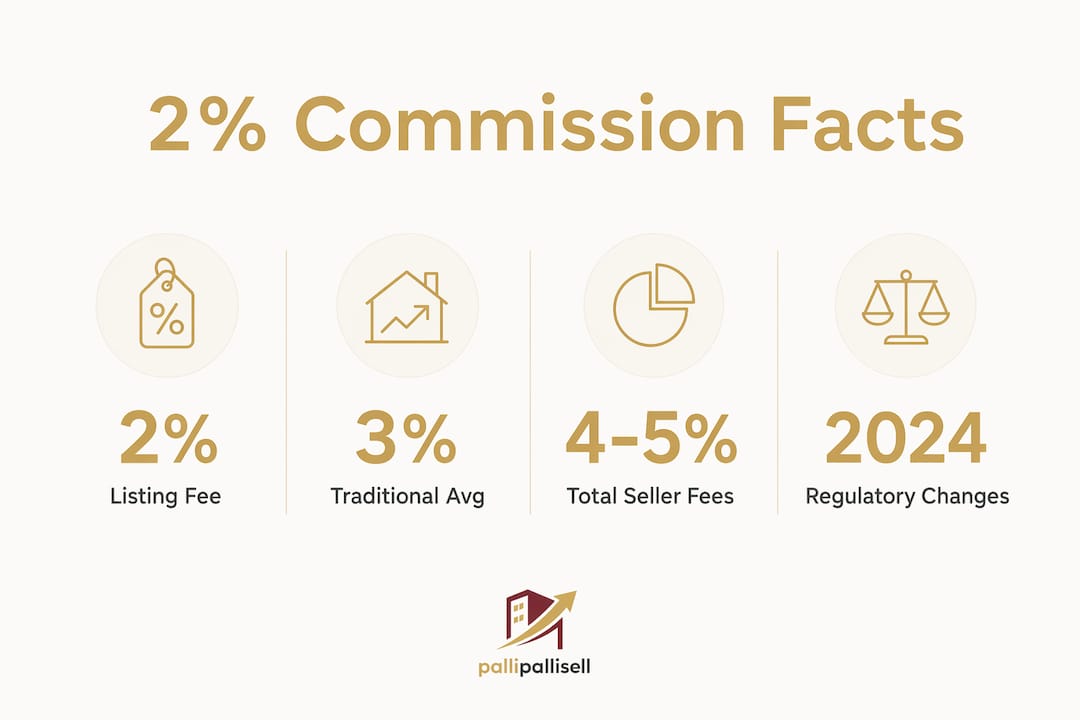
Listing agents typically earn between 2.8% and 3% of the sale price under traditional commission structures. An agent charging 2% is already offering a discount from that standard. The savings to you as a seller amount to roughly 0.8% to 1% of your property’s value, which on a $1,000,000 HDB flat translates to $8,000 to $10,000 in your pocket.

The commission structure in real estate also reflects the agent’s business model. Agents who operate independently, without franchise overhead or large team splits, can price at 2% and still maintain healthy profit margins. The rate is not a sign of reduced service. It is a sign of a leaner operation.
How do rising property values and market competition shape the 2% rate?
Rising property prices in Singapore have fundamentally changed what a percentage commission means in dollar terms. When a flat sells for $600,000 versus $1,200,000, the same 2% rate produces double the income for the agent. Home price increases mean lower percentage commissions still generate substantial agent income. This is the core reason 2% has become viable where 3% once felt necessary.
Market competition among agents also drives rates down. Discount brokerages now routinely advertise listing fees as low as 1% to 1.5%. That pressure forces traditional agents to justify their rates or lower them. The 2% rate sits in a practical middle ground, competitive enough to attract sellers and sufficient to fund a full marketing effort.
Several factors explain how agents sustain 2% pricing without cutting corners:
No franchise fees. Agents who own their brokerages avoid royalty payments that can consume 5% to 8% of gross commission income.
Lean team structures. Solo agents or small teams eliminate the internal splits that reduce each agent’s net earnings.
Technology-driven marketing. Digital listings on PropertyGuru, 99.co, and similar platforms cost far less than print campaigns, reducing overhead significantly.
Higher transaction volume. Agents charging 2% often close more deals to compensate, which keeps their annual income stable.
Pro Tip: Ask any agent presenting a 2% rate to show you their recent transaction history. Volume and speed of sale matter more than the rate itself.
How does a 2% fee compare to 3% or higher commission rates?
The difference between a 2% and a 3% listing fee is not just a number. It reflects different service packages, marketing budgets, and levels of agent involvement. Sellers need to understand exactly what they are buying at each price point.
One critical point most sellers miss: the 2% commission applies to the listing agent only. The buyer’s agent typically charges an additional 2% to 3%. Your total commission liability may reach 4% to 5% even when your listing agent advertises a 2% rate. That total cost is what you should compare, not just the listing side.
Feature | 2% Commission Agent | 3% Commission Agent |
Listing on major portals | Yes | Yes |
Professional photography | Sometimes included | Usually included |
Dedicated marketing budget | Moderate | Higher |
Open house coordination | Varies by agent | Usually standard |
Negotiation support | Depends on agent skill | Depends on agent skill |
Total listing cost (S$1M flat) | S$20,000 | S$30,000 |
The table shows that core services overlap significantly at both rates. The real differentiator is agent skill, not the commission percentage. A 3% agent who misprices your flat costs you far more than the 1% difference in fees.
Key questions to ask before signing any listing agreement:
What marketing channels will you use, and what is the budget?
How many properties have you sold in this district in the past 12 months?
Will you handle all viewings, or will I need to be present?
What is your average sale-to-list price ratio?
Pro Tip: Request a written marketing plan before agreeing to any commission rate. Agents who cannot produce one are not worth 2% or 3%.
How have 2024 regulatory changes affected commission negotiations in Singapore?
The 2024 National Association of Realtors settlement reshaped how commissions are negotiated and disclosed globally. While this settlement originated in the United States, its effects have influenced buyer and seller awareness in markets like Singapore. The core change: buyer-broker agreements must now be signed before property tours, and commissions are no longer preset through listing systems.
This shift gives sellers more control over how agent charges work. You can now negotiate buyer-agent compensation directly, rather than accepting a standard split. Sellers may offer less or propose that the buyer covers part of the buyer-agent fee. This flexibility can reduce your total commission liability meaningfully.
Practical steps Singapore sellers can take under the new framework:
Negotiate the buyer-agent fee separately. Offer 1% to 1.5% to the buyer’s agent instead of the traditional 2% to 3%.
Request itemized commission breakdowns. Ask each agent to separate listing fees from buyer-side compensation in writing.
Compare total cost, not just listing rate. A 2% listing fee with a 2.5% buyer-agent offer costs more than a 2% listing fee with a 1.5% buyer-agent offer.
Use the new agreement structure. Buyer-broker agreements now require explicit consent, giving you a clearer picture of what each party earns.
Singapore’s Council for Estate Agencies (CEA) governs local commission practices. Sellers should verify that any agent they hire is CEA-registered and that all fee agreements are documented before the listing goes live.
What are the most common misconceptions about the 2% agent commission?
The biggest misconception about a 2% commission is that it signals reduced service or a less capable agent. This is not accurate. Discount brokerages operate on lean business models, not reduced effort. Many 2% agents deliver the same core services as higher-priced competitors because their cost structure allows it.
A second common error is focusing on the commission rate instead of the net sale price. The biggest risk to sellers is mispricing, not the commission percentage. An agent who secures $30,000 above your asking price more than covers the difference between a 2% and a 3% fee. Agent negotiation skill impacts your final proceeds far more than a 1% fee difference.
A third misconception: all 2% agents are the same. Some discount commission services require sellers to handle staging, photography, or showings themselves. That shifts real costs onto you in time and effort, even if the fee looks lower. Always clarify what is included.
Here is a practical checklist for evaluating any agent on commission and service:
Confirm the commission covers both listing and transaction coordination, not just the listing upload.
Ask whether professional photography is included or billed separately.
Verify the agent’s track record with properties similar to yours in size, location, and price range.
Confirm the agent will attend all viewings and handle all buyer inquiries directly.
Get the full commission structure in writing, including any buyer-agent fees you are expected to offer.
Pro Tip: Top-producing agents sometimes lower their rate to capture market share during slow periods. If you are selling in a quieter quarter, you have more negotiating power than you think.
Key takeaways
The 2% listing commission is a competitive, market-driven rate that reflects lean brokerage models, rising property values, and post-2024 negotiation flexibility, not a reduction in service quality.
Point | Details |
2% applies to listing agent only | Buyer-agent fees add another 2%–3%, so total commission often reaches 4%–5%. |
Rising prices make 2% viable | Higher property values mean agents earn more in dollar terms at lower percentages. |
Agent skill outweighs fee rate | Mispricing costs sellers more than the difference between a 2% and 3% commission. |
Post-2024 rules give sellers leverage | Buyer-agent fees are now negotiable; sellers can offer less and reduce total costs. |
Lean brokerage models enable 2% | Agents without franchise fees or large team splits can charge less and still deliver full service. |
What I have learned about the 2% commission after watching Singapore sellers negotiate
Most sellers I have spoken with fixate on the commission rate before they have even asked the agent a single question about their marketing plan. That instinct is understandable. On a $1,200,000 flat, a 1% difference in commission is $12,000. That is real money. But the rate is the last thing you should negotiate, not the first.
The agents I have seen deliver the best outcomes for sellers are not always the cheapest. They are the ones who price accurately from day one, respond to buyer inquiries within hours, and know how to hold firm in negotiation without losing the deal. A seller who saves 1% on commission but accepts an offer $40,000 below market value has made a poor trade.
That said, the 2% rate is entirely legitimate when the agent backs it up with a clear marketing plan and a documented track record. Agents who own their brokerages and operate without franchise overhead can offer full service at 2% and still run a profitable practice. The rate alone tells you nothing. The agent’s last 10 transactions tell you everything.
My honest advice: before you sign any listing agreement, ask the agent to show you their average sale-to-list price ratio for the past year. If they cannot produce that number, walk away regardless of what commission they are offering.
— Brandon
Pallipallisell: a lower-cost path for Singapore property sellers
If you have read this far, you already know that agent commissions add up fast. A 2% listing fee on a $900,000 HDB flat is $18,000 before the buyer-agent side is even counted.
Pallipallisell offers Singapore property sellers a direct alternative. Instead of paying percentage-based commissions, you list your HDB flat or private home for a fixed fee of $688. You keep full control over viewings, negotiations, and closing. The platform handles listing uploads, buyer inquiries, and transaction support without the commission markup. For sellers who want to sell without an agent and keep more of their sale proceeds, Pallipallisell is a straightforward option worth comparing against any agent quote you receive.
FAQ
What does the 2% commission cover in a property sale?
The 2% commission covers the listing agent’s services, including marketing, viewings, negotiation support, and transaction coordination. It does not include the buyer’s agent fee, which is charged separately.
Is a 2% commission agent less effective than a 3% agent?
Not necessarily. Agents with lean brokerage structures can deliver full service at 2% because they have lower overhead costs. Agent skill and track record matter more than the commission rate.
What is the total commission a Singapore seller typically pays?
Total commission often reaches 4% to 5% when both the listing agent and buyer’s agent fees are combined. The advertised 2% rate applies only to the seller’s agent side of the transaction.
Can sellers negotiate the buyer-agent commission in Singapore?
Yes. Since the 2024 NAR settlement changed how buyer-broker agreements work, sellers have more flexibility to offer lower buyer-agent compensation or negotiate how that fee is split with the buyer.
Does a lower commission rate mean I will net more from my sale?
Not automatically. Agent negotiation skill and accurate pricing have a larger impact on your net proceeds than the commission percentage. A well-priced property sold at full market value outperforms a discounted commission on an underpriced listing.
Recommended


Comments